

You ate well yesterday, went for a walk and went to bed on time. This morning, the scale says you’re up two pounds.
It’s one of the most discouraging moments in any weight goal, and it’s almost never what it looks like.
A single weigh-in measures everything in your body at that moment: water, food that hasn’t been digested yet, stored carbohydrate and the water bound to it, as well as fat and muscle. Most of the day-to-day swing comes from the first three.
Fat changes slowly. You only see it clearly when you look at weigh-ins across a week or more.
What moves the scale from one day to the next
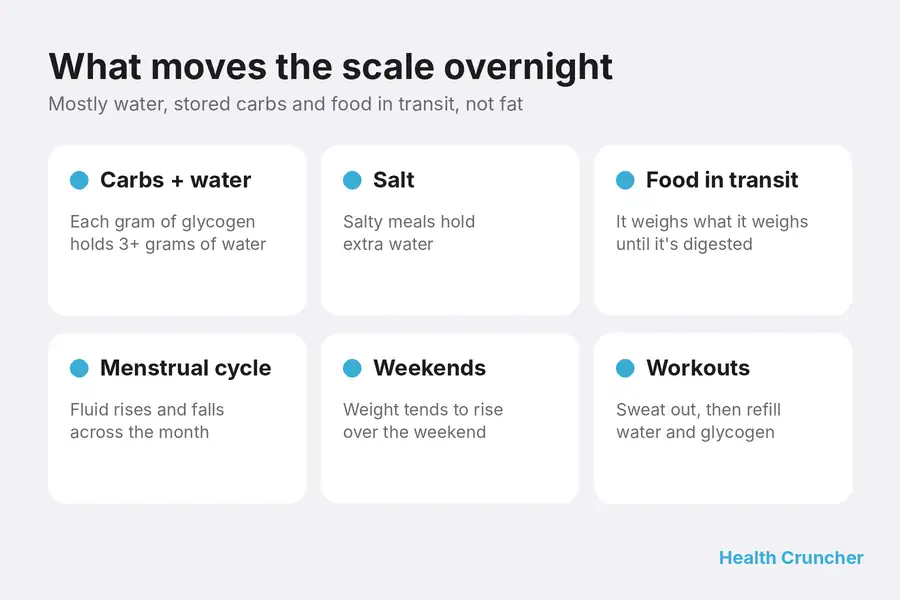
Carbohydrates and the water stored with them
Your muscles store carbohydrate as glycogen, and glycogen is stored with water. A study that took muscle biopsies after exercise found that each gram of glycogen was stored with at least 3 grams of water.1
So a pasta dinner or a holiday meal that tops up your glycogen brings water along with it. At that ratio, storing an extra 200 grams of glycogen would add roughly 600 grams of water, about 1.3 pounds, without a gram of new fat.
It works the other way too. That’s why the first week of a low-carb diet often shows a big drop that then slows down: a lot of it is glycogen and water, not fat.
Salt
Sodium shifts body water too. In the DASH-Sodium feeding trial, calories were adjusted to hold weight steady, and people still weighed about 0.2 to 0.3 kg (around half a pound) less on the low-sodium diet than on the high-sodium one.2
Their urine volume and thirst changed with sodium as well. A salty restaurant meal can show up on tomorrow’s scale for that reason alone.
Food and drink that’s still on its way through
Whatever you ate and drank recently still weighs what it weighs until it’s digested and passed. A late dinner, a big glass of water before bed, or a day without a bowel movement all show up on the scale.
None of it is fat.
The menstrual cycle
Fluid retention rises and falls over the menstrual cycle. A year-long prospective study followed it across women’s cycles.3
If you menstruate, comparing a weigh-in from one phase with one from another can make a steady month look like a gain. It helps to compare the same point in different cycles, or to use averages that span the whole month.
Weekends
Weight has a weekly rhythm for many people. A study that tracked daily weigh-ins found that weight tends to rise over the weekend and come back down during the week.4
A Monday weigh-in is often your highest of the week, which makes it a bad day to judge your progress on.
Workouts
A long or hard session can leave you lighter from sweat, then heavier the next day or two as you rehydrate and refill glycogen.
A new or tougher program can also leave muscles holding extra fluid while they recover. Both are normal and short-lived.
How to see the real trend: average a week at a time
The fix isn’t to weigh yourself less. It’s to stop comparing one morning with the next.
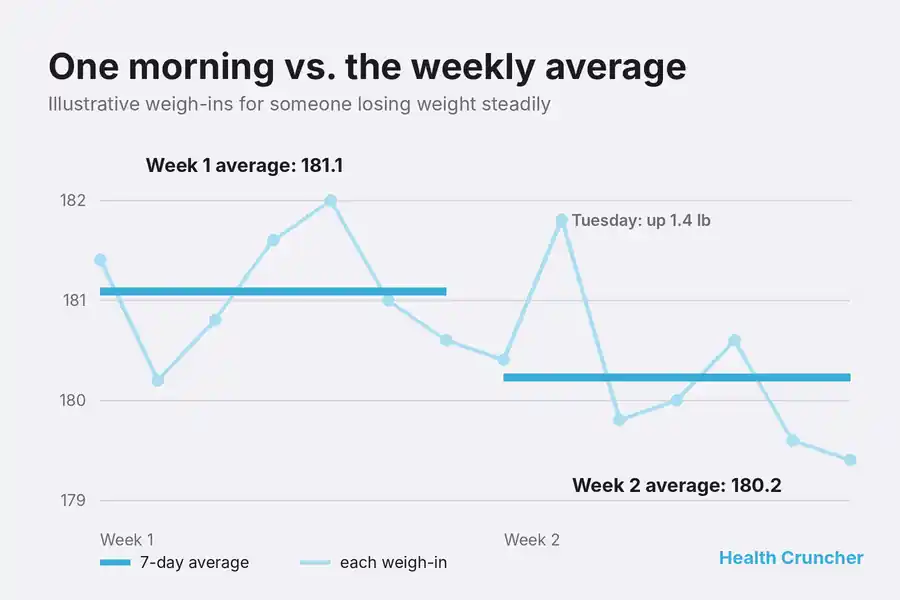
Weigh in on as many mornings as you can, then compare the average of the last 7 days with the average of the 7 days before. The daily noise largely cancels out, and what’s left is the direction you’re actually heading.
Here’s an illustration, using made-up numbers for someone losing weight steadily:
| Day | Week 1 (lb) | Week 2 (lb) |
|---|---|---|
| Monday | 181.4 | 180.4 |
| Tuesday | 180.2 | 181.8 |
| Wednesday | 180.8 | 179.8 |
| Thursday | 181.6 | 180.0 |
| Friday | 182.0 | 180.6 |
| Saturday | 181.0 | 179.6 |
| Sunday | 180.6 | 179.4 |
| 7-day average | 181.1 | 180.2 |
Look at week 2’s Tuesday: up 1.4 pounds from Monday. Taken alone, that reads like a bad day.
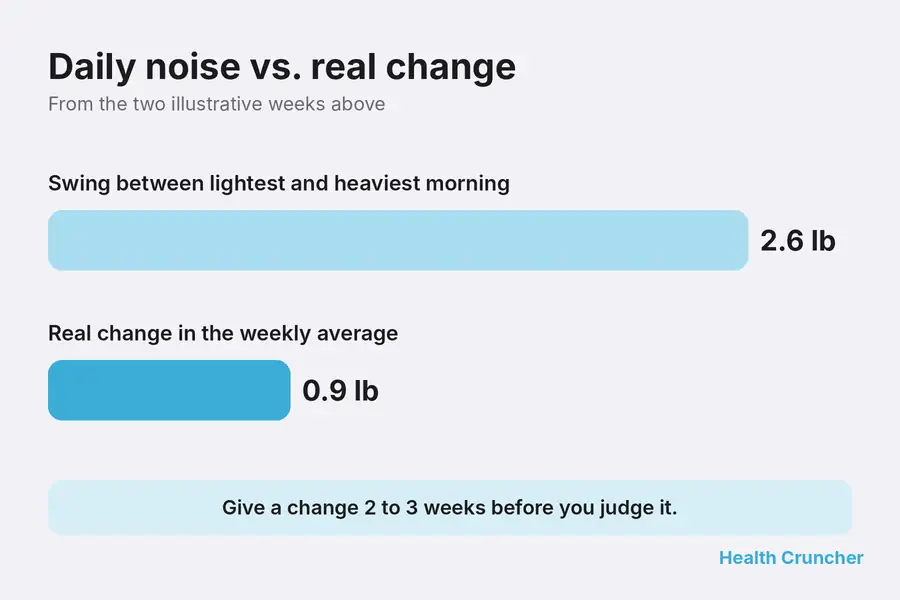
But the weekly averages show a drop of 0.9 pounds, which is the real story. The swing from the lightest to the heaviest morning across these two weeks is 2.6 pounds, almost three times the actual change.
A few habits make the average more reliable:
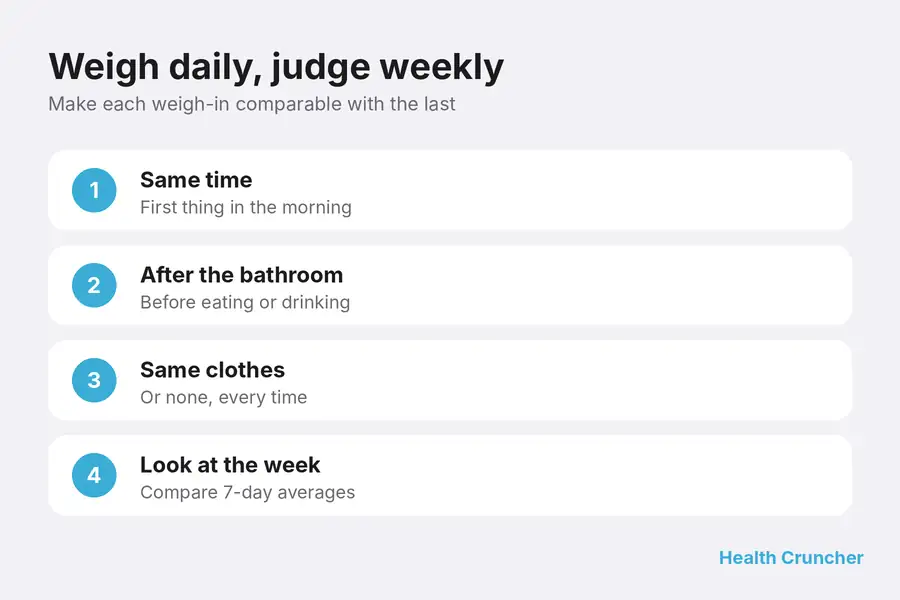
- Same time, same conditions. First thing in the morning, after the bathroom, before eating or drinking, in the same (or no) clothes.
- More weigh-ins, not fewer. An average of six mornings is steadier than an average of two. Missing days is fine, but don’t base the week on a single reading.
- Give a change two to three weeks. One week of averages can still be clouded by a salty weekend or a heavy training block. Two or three weeks pointing the same way is a trend.
- Add a tape measure. Waist measurements move with fat, not with yesterday’s dinner. If your weekly weight stalls but your waist is shrinking, you’re still losing fat; the body fat calculator shows where to put the tape.
Is weighing every day a good idea?
For many people, yes. In a trial titled, fittingly, “Weighing every day matters,” adults who weighed themselves daily lost more weight and adopted more weight-control habits than a control group.5
Daily weighing works best when you treat each number as one data point in an average, not a verdict on yesterday.
It isn’t for everyone, though. If seeing the number every morning makes you anxious or pushes you toward skipping meals, weigh less often and focus on measurements or how your clothes fit.
Talk with your doctor about what’s right for you.
When a change is real
Lasting changes in body fat come from a sustained gap between the energy you take in and the energy you use, over weeks and months.6 That’s why a single day can’t undo a month of progress, and one great day can’t make it either.
If your weekly average has moved the wrong way for several weeks, check your calorie target again with the TDEE calculator or calorie calculator. If it’s been flat for a while, our guide to breaking through a plateau covers what to try next.
A sudden, unexplained gain is different from everyday water weight, especially with swelling in your legs or feet or shortness of breath. Talk with a doctor about that.
Let an app do the averaging
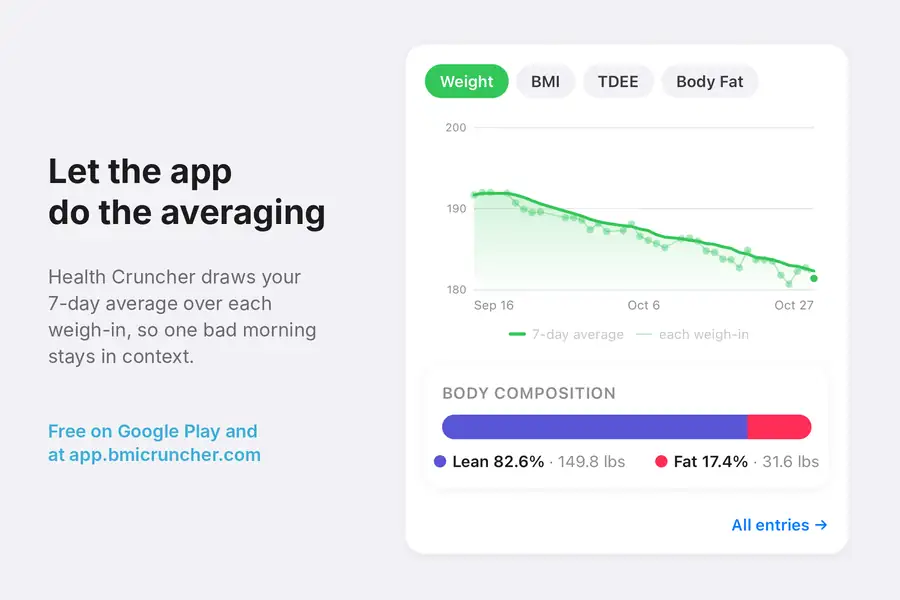
Working out weekly averages by hand gets old fast. Our free Health Cruncher app does it for you.
Log your weight each morning, and the dashboard compares this week’s average with last week’s, with the change since your last weigh-in underneath. Its charts draw each weigh-in faintly behind the trend line, so a bad Tuesday stays in context.
It’s free on Google Play and on the web at app.bmicruncher.com.
The short version
- Overnight swings are mostly water, stored carbohydrate and food in transit, not fat.
- Salt, carbs, weekends, workouts and the menstrual cycle all move the scale.
- Compare this week’s average with last week’s, not today with yesterday.
- Give any change two to three weeks before you judge it, and use a tape measure alongside the scale.
Sources
- Fernández-Elías VE, et al. Relationship between muscle water and glycogen recovery after prolonged exercise in the heat in humans. Eur J Appl Physiol. 2015. PubMed
- Juraschek SP, Miller ER 3rd, Chang A, Anderson CAM, Hall JE, Appel LJ. Effects of sodium reduction on energy metabolism, weight, thirst, and urine volume: results from the DASH-Sodium trial. Hypertension. 2020;75(3):723–729. PMC
- White CP, Hitchcock CL, Vigna YM, Prior JC. Fluid retention over the menstrual cycle: 1-year data from the Prospective Ovulation Cohort. Obstet Gynecol Int. 2011. PMC
- Orsama AL, et al. Weight rhythms: weight increases during weekends and decreases during weekdays. Obes Facts. 2014. PubMed
- Steinberg DM, et al. Weighing every day matters: daily weighing improves weight loss and adoption of weight control behaviors. J Acad Nutr Diet. 2015. PubMed
- Hall KD, Sacks G, Chandramohan D, et al. Quantification of the effect of energy imbalance on bodyweight. Lancet. 2011;378(9793):826–837. PubMed
This article is for general information and isn’t medical advice. Talk with your doctor before making major changes to your diet or exercise, or if you notice a rapid change in your weight you can’t explain.

Leave a Reply