

A tape-measure body fat estimate is only as good as the tape placement. The body fat calculator uses the U.S. Navy circumference method, which turns your neck, waist (and, for women, hip) measurements and your height into a body fat percentage.1,2
Measure an inch or two away from the right spot and your result can move by several points. Here’s where to put the tape, and how to get the same reading every time.
What you need
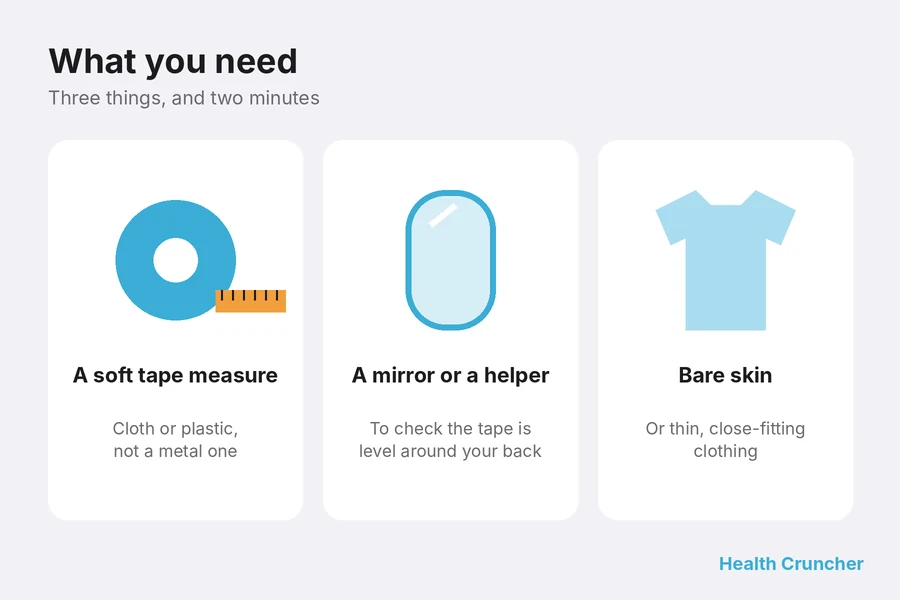
- A flexible cloth or plastic tape measure (not a metal one).
- A mirror, or someone to check the tape is level around your back.
- Bare skin or thin, close-fitting clothing.
Where to measure
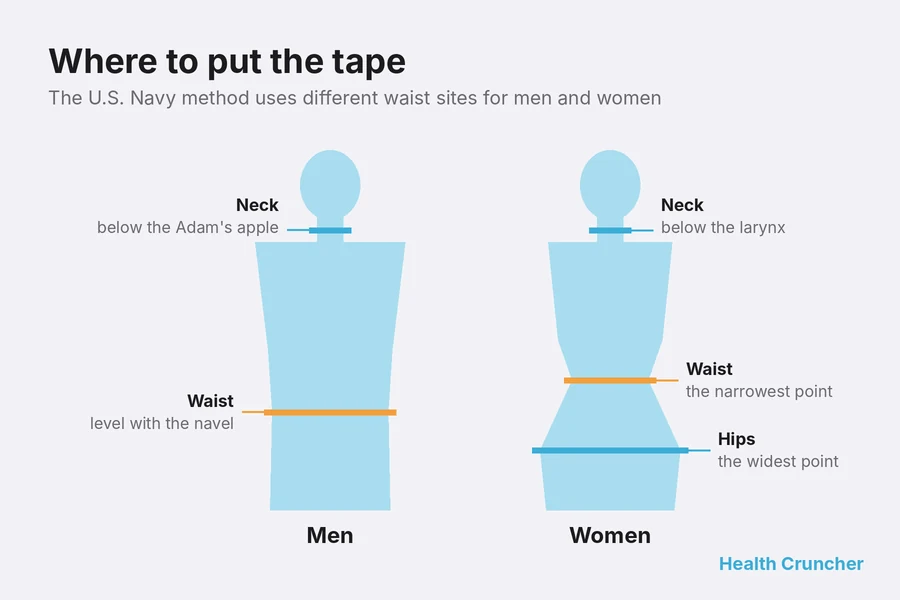
The Navy equations were built on specific measurement sites, and the waist site is different for men and women.1,2 Use the sites the equation expects, even if another spot feels more natural.
| Measurement | Men | Women |
|---|---|---|
| Neck | Just below the Adam’s apple (larynx) | Just below the larynx |
| Waist | Level with the navel (belly button) | At the natural waist, the narrowest point |
| Hips | Not used | At the widest point of the hips and buttocks |
| Height | Standing straight, shoes off | Standing straight, shoes off |
Men: measure the waist at the navel, not the narrowest point
This is the most common mistake. Many men measure where their waist is narrowest, which usually sits above the navel and reads smaller.
The men’s Navy equation was built with the waist measured at the navel,1 so a narrower reading makes your body fat look lower than the equation intends.
Here’s how much it matters. Take a man who is 5′11″ and 180 lb with a 15-inch neck. If his waist measures 36 inches at the navel but 34 inches at its narrowest point, our calculator gives:
| Waist used | Body fat | Waist-to-height ratio |
|---|---|---|
| 34 in (narrowest point) | 17.0% | 0.48 |
| 36 in (navel) | 20.7% | 0.51 |
Two inches of tape position moves the estimate by almost 4 points, and moves his waist-to-height ratio across the 0.5 line that research has linked to higher cardiometabolic risk.3 Neither number is “wrong” as a measurement, but only the navel reading is the one the equation was designed for.
Women: natural waist and widest hips
The women’s Navy equation uses the natural waist, the narrowest part of your torso between your ribs and hips, plus the hips at their widest point.2 To find the hip site, stand with your feet together and slide the tape up and down over your hips and buttocks until it reads the largest number.
How to take each measurement
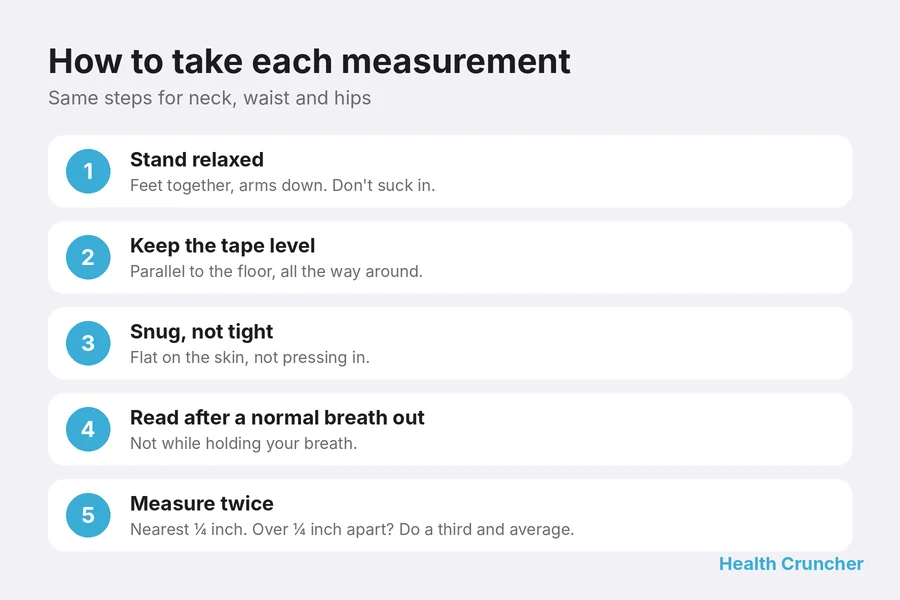
- Stand relaxed. Feet together, arms by your sides, looking straight ahead. Don’t suck in your stomach or flex.
- Keep the tape level. It should run parallel to the floor all the way around, including across your back.4 A tape that dips at the back reads too large.
- Snug, not tight. The tape should sit flat against your skin without pressing into it.4,5
- Measure the waist after a normal breath out. Breathe normally and read the tape at the end of the out-breath, not while holding your breath.4,5
- Read to the nearest quarter inch (or half centimeter). Then take a second reading. If the two differ by more than a quarter inch, measure a third time and use the average.
Why other guides tell you something different
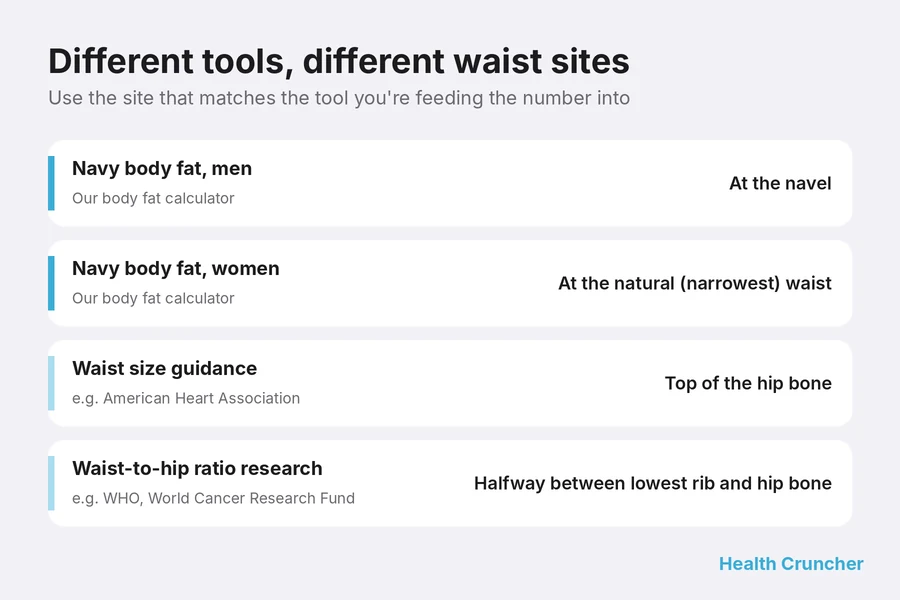
You’ll find several “correct” waist sites online, and that’s because different tools use different ones. Health guidance on waist size often measures at the top of the hip bone4 or halfway between the lowest rib and the top of the hip bone.5,6
The cutoffs that come with that guidance were set using those sites. The Navy body fat method uses its own sites, listed above, so use the site that matches the tool you’re feeding the number into.
For tracking, the most important rule is simpler: measure the same way every time. Same site, same time of day (morning, before eating, works well), same tape.
How accurate is the result?
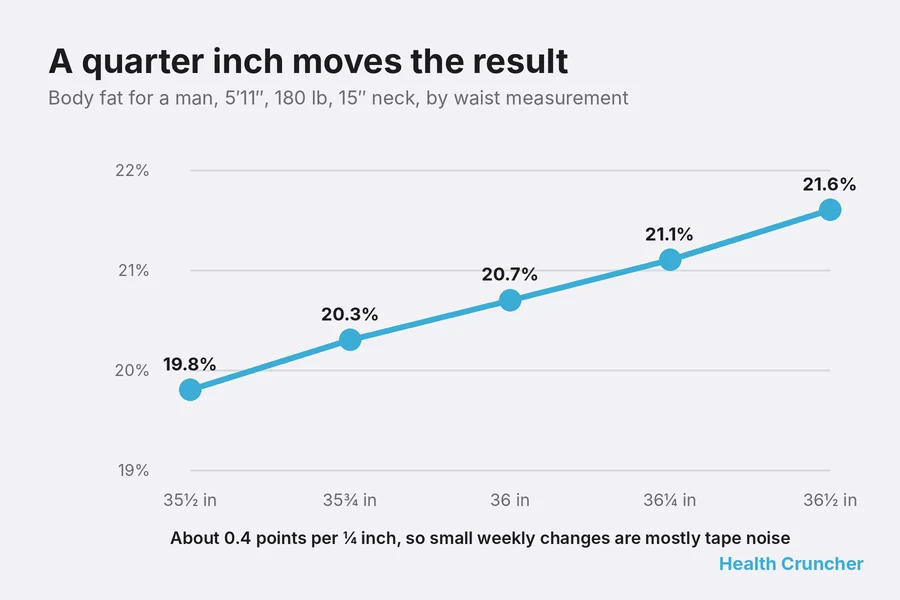
The Navy method is an estimate built from body measurements, not a direct measurement of fat. It’s quick, free and repeatable, which makes it good for watching your own trend over weeks and months.
Small changes are mostly the tape: for the man above, each quarter inch of waist moves the result by about 0.4 points. So a change of a few tenths from one week to the next is mostly measurement noise, while a steady drift over a month or two is worth paying attention to.
For more on what body fat percentage does and doesn’t tell you, see Understanding Body Composition.
Put your measurements to work
The same three measurements feed several calculators:
- Body fat calculator: body fat percentage, fat mass and lean mass.
- Waist-to-height calculator: a simple screening ratio; keeping your waist under half your height is the usual guide.3
- Waist-to-hip ratio calculator: compares your waist with your hips.6
To track them over time, our free Health Cruncher app lets you log your neck, waist and hips alongside your weight. It charts your weight, waist, body fat and lean mass as they change.
It also shows where to put the tape right under the measurement fields. It’s free on Google Play and on the web at app.bmicruncher.com.
Sources
- Hodgdon JA, Beckett MB. Prediction of percent body fat for U.S. Navy men from body circumferences and height. Report No. 84-11. San Diego: Naval Health Research Center; 1984. PDF
- Hodgdon JA, Beckett MB. Prediction of percent body fat for U.S. Navy women from body circumferences and height. Report No. 84-29. San Diego: Naval Health Research Center; 1984. PDF
- Ashwell M, Gunn P, Gibson S. Waist-to-height ratio is a better screening tool than waist circumference and BMI for adult cardiometabolic risk factors: systematic review and meta-analysis. Obes Rev. 2012;13(3):275–286. PubMed
- American Heart Association. Measuring waist circumference (quick guide). PDF
- World Cancer Research Fund. How to measure your waist. wcrf.org
- World Health Organization. Waist circumference and waist-hip ratio: report of a WHO expert consultation. Geneva: WHO; 2008 (published 2011). who.int
Body fat estimates are for general information and aren’t a medical assessment. BMI Cruncher and Health Cruncher are made by Group Eighteen, LLC.

Leave a Reply